![Help[H]er Substack](https://substackcdn.com/image/fetch/$s_!qiRV!,w_120,h_120,c_fill,f_webp,q_auto:good,fl_progressive:steep/https%3A%2F%2Fsubstack-post-media.s3.amazonaws.com%2Fpublic%2Fimages%2Fec7fadee-aef6-4de3-9bf3-f8cedf5dfd37_1280x1280.png)
Under-Rowing
Stewarding platforms for the sake of flourishing others


As I continue to integrate aspects of my own story into these Substack posts, please know I’m doing okay. Sure, I still have random triggers. Like when I search for an old email and a communication from a difficult time pops up. Or that flight/fight/flee feeling if I see a former church “friend” on Facebook or in my local Target. But overall, my processing has been good, and it continues to lead me toward gratitude. God really has provided peace. I can remind myself He is inviting me to share not only in Christ’s sufferings, but also to comprehend suffering on a whole other level for the sake of learning and helping others. I don’t say that to guilt anyone who isn’t experiencing the same, I simply want to tell readers that I’m not sharing my personal story for the purpose of lamenting, rather I share because I know there will be those who can relate. Far too many women have a similar, if not same, situation. I want them to know I know on a whole other level of knowing. So, my story on these pages progresses.
On that note, I’ve been thinking a lot about another of the accusations leveled at me during that “investigation” (that wasn’t supposed to be considered an investigation). It’s laughable, to be sure. But leadership in one of the most significant “platform” churches in the PCA literally told me, “I understand and appreciate the vital role you played in leading and executing so many aspects of [the HelpHer resources]. However, our participation in this project and agreed partnership1 with CDM was not intended to, in effect, platform another ministry or person. We would not have moved forward with the use of our platform (both facilities and name) for this project if we thought that to be the case.” (emphasis mine)
This artwork is what came to my mind. It continues to haunt me.
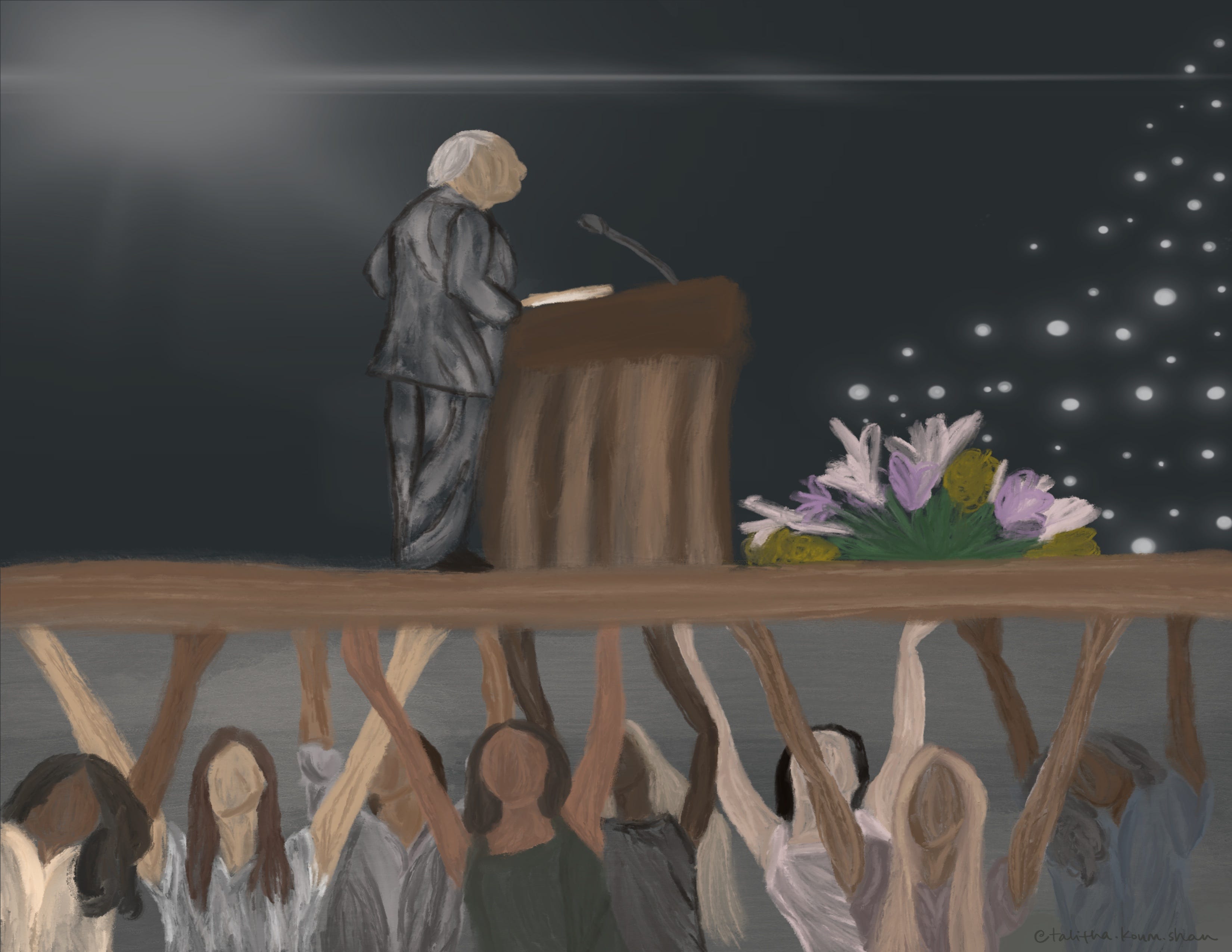
“The Unseen Ministers,” Artwork by Talitha Koum Shan on Etsy
I can assure you “platform” was the absolute last thing on my mind. If the new leadership at our church had taken any time whatsoever to get to know me, they would have known how much I deplore Christian celebrity. This disapproval is grounded in both professional and personal convictions.
Professionally I disapprove because the “high places” Christian celebrities adore have little to do with demonstrating and glorifying God, and more to do with satisfying and elevating self. See this excellent article for more on that topic…

Let me ask you this question. Who was the biggest personality at your most recent Sunday worship service? How about at the Saturday morning women’s prayer breakfast? If it was anyone but Christ, you’ve got a celebrity church and a platform problem. If we are simply listening to a monologue, complete with jokes, personal impressions, and clever arguments, we are the culture that enables Christian celebrity. Not sure yet? Well, what did you learn about said celebrities walk with the Lord? Does the celebrity talk to you as a real person, not as an inconvenience? Do they share in the daily life of the congregation or are they booked out for months because they are on the speaking circuit? Does this person confess and ask forgiveness specifically when they have sinned (or made a mistake)? How about suffering, what do they tell you? In rooting out their own sin, do they exhibit genuine repentance? What did they teach you about caring for the oppressed? What did they share about how they contribute to that problem? How you answer these questions might be telling.
I also have personal convictions regarding celebrity and platform, many of which were shaped by early experiences wearing the skin of the female gender. If you are a woman who has been objectified for a man’s purposes you may also experience this similar dynamic. That’s not to say the following is everyone’s response to objectification, it is to suggest it is one way.
As a young girl I was tall for my age, thin, and I developed early. My parents actually enrolled me in modeling school to encourage improving my stature. At 13, I learned how to accentuate my outward appearance, stand up straight, walk tall, dress for success, and exude confidence in who I was (as it related to what I looked like). At that time, I could have easily passed for 16.
My childhood experiences also included accompanying my Dad as he worked in the building trades. I spent a lot of time on construction sites. This would be some of my earliest memories of cat calls, lewd suggestions (spoken or demonstrated), and even more vulgar physical proposals. As a kid, I hung out in all the other places my parents went as well. Like, every Saturday afternoon, after all our family chores and errands were done, you might find me playing air hockey at the local tavern. My Dad and his buddies gathered weekly for a few beers and friendly verbal jostling one another. After a few drinks, my father’s friends would, shall we say, get more friendly with me. Their comments mimicked construction workers at a jobsite. But not just their comments.
I was observed, checked out from floor to ceiling.
I was hugged, unapproved by me, and hands generally fell in conspicuous places.
I was ogled, and I felt it. Literally in my body and mind.
I was examined, front and back. And sometimes the examiner shared their observations.
The lust in their drunk eyes made me sick to my stomach. So, I compensated. I began to wear clothes that disguised my developing figure. I learned how to get out of situation before someone came in for that “hug.” And I avoided walking in front of people. It got so bad I would not walk to the front of a classroom to turn in an assignment without a panic attack (though I didn’t know what that was at the time). I would tremble and cry if my mom asked me go in the local Chinese restaurant to pick up our food order. I’d shrink to the nearest corner in EVERY situation where there might be men potentially gazing.
One might think I’d grow out of such ogling as I got older. But I distinctly remember as a 30 something new mother, shrinking inside as I walked through an airport in an Eddie Bauer, heavily lined trench coat while still witnessing eyes bounce top to bottom and that smirk as businessmen walked by. Or the times I sat in ministry meetings and, despite no eyes bouncing up and down my body, I could sense the awkward “heat” in the room.2 And lest you find yourself rationalizing men’s behaviors because my childhood experience happened in a bar, there was also that time when I was well into my 50’s that “the hug”[3 happened once again…in my seminary.
I am aware that, because of these instances, my go-to remains “FLEE!” to this day.
Please know, many women have had it far, far worse. I don’t want to diminish those victims nor their experiences. These were just (some of) mine, and they certainly shaped me.
Back to platform. You might be able to see where I’m going with this. Over the years, God has provided places for my voice to be heard. It has taken all of the strength I can muster to agree to occupy those spaces. It doesn’t come without a cost. I know many people have a difficult time speaking in front of others. That’s a problem I also have, for sure. But what it takes to put my body out there in front of people is sheer agony. Those who DO know me know I avoid it at all costs. So, to hear from church leaders that all I was after was a platform, propelled me to prove their theory wrong.
You with me still? Here’s the point of this post.
Recently, I’ve begun working with a coach. She’s a WONDERFUL woman who encourages what she sees in me from an outside perspective. I’ve shared my “platform avoidance disorder” with her and asked (seriously) how I can promote the Help[H]er ministry, find donors, supporters, encourage victims and survivors to get help, without having to create a platform. I pretty much concluded what she’d say before she even spoke.
You don’t.
In order to get a ministry structured, to network and find those willing to support the needs, the executive director needs to be “out there,” vision casting, sharing, and promoting.
Ick.
Yet, my coach has been “coaching” me to a new way of thinking about this topic. She’s encouraged me to see a platform as something used for the good of others, rather than platforming for oneself. She suggested I flip the artwork (The Unseen Ministers) I posted above literally on its head and encouraged me to see it as me holding up the stage for those I help while they are on top. A platform that encourages their flourishing. One that renews their importance, their God given uniqueness, and His image shining through them and their circumstances.
Coincidentally, I recently read a devotional in Diane Langberg’s In Our Lives First, vol 2. In it, she exegeted the Corinthian people around the time Paul wrote them his letters. Listen to some of the ways she articulates the ungodly, unrighteous aspirations of those people at that time. Many, if not all, provide incredible insight into a community shaped by driven aspirations, social climbing, and clever rhetoric—some of the things celebrity cultures are made of.
Loved wealth
Loved lust
Centered on the intellectual
Centered on clever arguments
Centered on the philosophical arguments of the hour
Had God’s name (they were new Christians), but departed from His ways
Obscured the presence of Jesus
Obscured His splendor
Gathered around their own views and ideas
Created church schisms based on opinions
Focused on the material
Lost understanding of spiritual
Moral failures rocked the church
Sin was ignored or covered up
Failure to deal with sin
Didn’t bring sin to light
Didn’t grieve sin
They were rotten to the core, corrupt and lewd
What would it look like to pursue a platform that, instead, had those we serve at the center and not ourselves? Certainly, no less than the opposite of those things above.
Use wealth to support others
Thirst for the ways of God
Center on the whole person
Center on being the most (genuinely) humble person in the room
Center on truth
Follow His ways
Step aside to give Christ His glory
Gather around other people’s needs and what’s best for them
Reciprocally share and hear opinions
Focus on the eternal
Seek further understanding of the spiritual
Eradicate moral sin in Christ’s body, take steps toward healing and redemption instead
Transparency
Sin acknowledged (BY ALL)
Sin scoured out
A posture of lament
Whitewashed tombs revealed
Basically, it would look a lot like an under rower, ὑπηρέτης (hupēretēs).
“This is how one should regard us: as servants (under-rowers) of Christ and stewards of the mysteries of God” 1 Corinthians 4:1.
This is where I cite Chat GPT.
“Here’s the nuance:
Not the captain – Paul isn’t the one steering the ship; Jesus is.
Obedient role – Like an under-rower, he takes orders from the one in command.
Hidden service – Most of the work is unseen by the public.
Team effort – The ship only moves if all rowers work together in sync.”
This is a definition I feel I can get behind. Literally! In all my years of hiding from spotlights, this gives me the courage I need in order to pursue a “platform” for those I am called to serve. Paul did not shy away from platform. In Athens he literally jumped on the platform. But his purpose was not his glory. His purpose was to show off the glory of his captain, Jesus. The problem is not platform. The problem is whether one rightly understands their role on the ship, in word, mind, and deed. As I hold this calling from the Lord in my hands, Paul’s example of under-rowing guides me.
Anyone want to under-row with me?
This was one of the lies I confronted, but it became part of their narrative. Christ Covenant Church has no proof of a “partnership” with CDM for the materials I developed and produced because those agreements were made with an individual. Me.
In at least two of those situations, the “ministers” involved were later outed as sexual addicts (infidelity and prostitution included). I don’t believe I was just imagining something was amiss.
For a “hug” example, https://www.nbcnews.com/news/us-news/bishop-apologizes-inappropriately-touching-ariana-grande-aretha-franklin-funeral-n905796
What is victim theology?
Ruth Barron coined the term and with her husband's help she wrote this definition:
“Victim theology offers answers to the questions that victims are asking; traditional theologizing typically fails to answer this set of questions. Victim theology is theology that recognizes the reality of the contexts and trauma experienced by victims and also acknowledges that victims’ voices offer a theological perspective that is valuable, needed, and is too often silenced. Victim theologians are those who have been victims of abuse who acknowledge the fact that they are victims but who refuse to allow their status as victims to be vilified or shamed. Instead, they rightly insist that the shame belongs to abusers, to those who shelter or abet abusers, and to bystanders who look the other way, dismissing abuse as unimportant. Victim theology enables Good Samaritans to take positive action: holding abusers accountable, giving respite and support to victims, and providing protection to the vulnerable. Because victim theology recognizes that in the context of abuse the victims are the sinned-against whereas the abusers (and those complicit with abusers) are the sinners, victim theologians offer more robust and better balanced theologies to the Church regarding the reality of abuse in her midst.”
— Ruth Barron & Joshua Barron
A shorter summary is:
“Victim theologians are those who have been victims of abuse who acknowledge the fact that they are victims but who refuse to allow their status as victims to be vilified or shamed; instead, they speak theologically into their own context — abuse in the Church — offering robust and better balanced theologies to the Church regarding this reality.”
Here's a link to Ruth's comment at my blog where she gives the definition: https://cryingoutforjustice.blog/2025/07/29/the-jigsaw-puzzle-of-divorce-texts-in-the-bible-putting-the-pieces-together-to-reach-an-ethical-conclusion-is-not-enough/#comment-175425
Flipping the artwork (The Unseen Ministers) is a helpful beginning. But flipping it is not enough: the white man in the baggy suit at a pulpit needs to be overpainted.
(And if any man reading this takes offence, I respectfully ask him to join the women under-rowers, rather than lording it over us.)
I picture a woman in everyday clothes below the platform with her hands and voice upraised. She is holding up the platform for:
— the myriads of abused women who want to expose the nefarious tactics and deeds of their abusers,
— the victim theologians who are expounding scripture through the wisdom of their lived-experience as victims.
Ruth Barron coined the term “victim theology”. To read her definition of the term, go here:
https://www.facebook.com/share/p/16q5ME2iDD/?
In my view, Anna Anderson is a victim theologian.
So is Carya, your storyteller on the current season of Safe To Hope. https://helpher.help/caryas-story-part-4/
And I think a lot of what I’ve written is victim theology.
I will be an under-rower with you, Ann Maree! 🥰